GTXR
June 19th, 2021 by Lillian Tso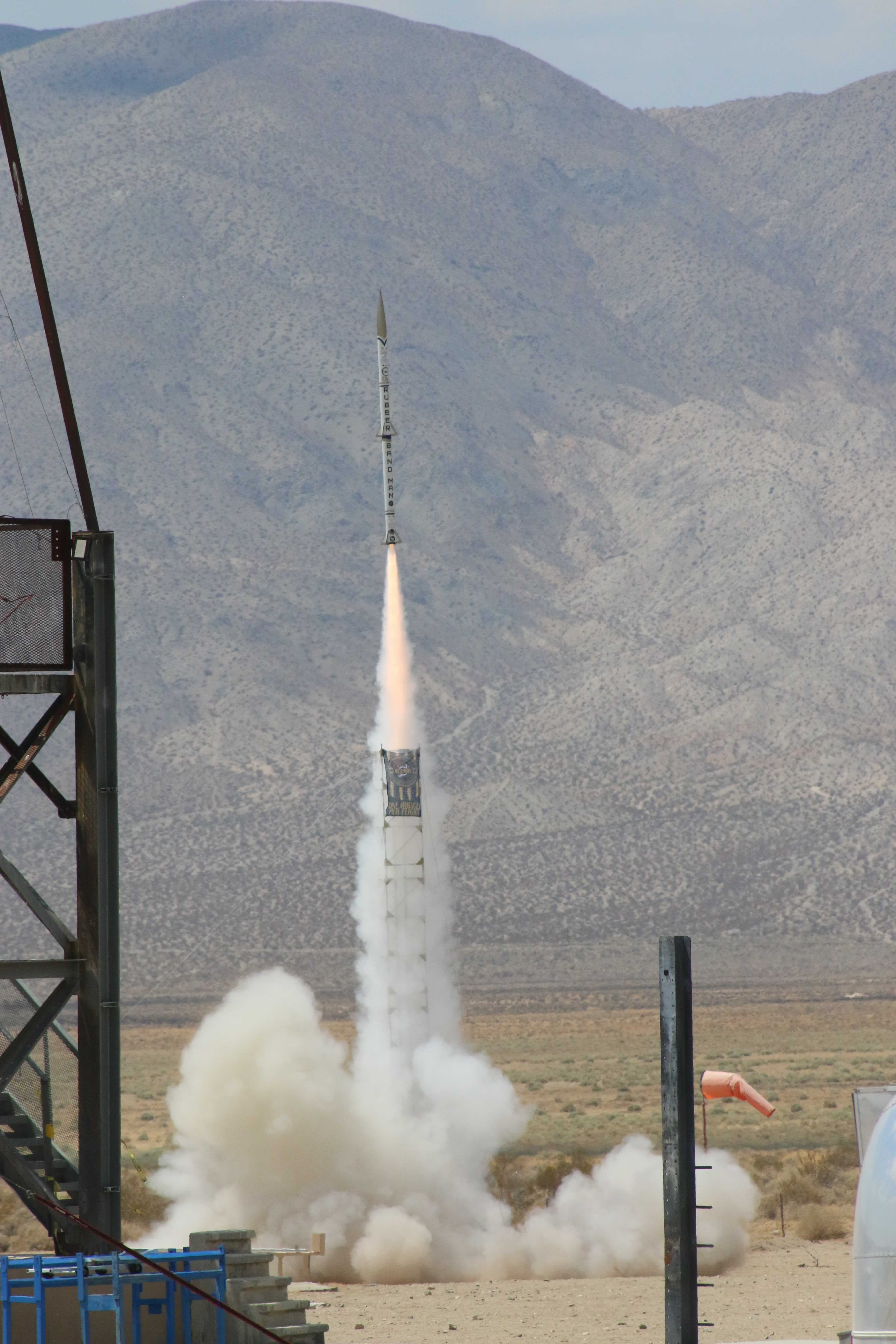
Rubberband Man
June 19, 2021
What happens when you put 30 college students into a hot desert in the middle of nowhere with no rules and explosives? Oh yeah, we launch a rocket into the sky.
Our work over the past two years culminated into Rubberband Man: a two stage, solid motor launch vehicle capable of hitting altitudes of over 30,000 ft. For the past semester, I worked on recovery and vehicle testing which is developing the parachute operations for the launch vehicle and ensuring that all flight operations perform nominally during the launch. When we got out into the Mojave Desert and the Friends of Amatuer Rocketry (FAR) Launch Site, I had the responsibility of packing flight ready parachutes and stuffing them into the tubes.
I am a part of the Georgia Tech Experimental Rocketry (GTXR) Team; a team which is composed of 30 undergraduates spanning Aerospace Engineering, Mechanical Engineering, and Business. Rubberband Man is the second rocket to be launched from the team; the first being “Sustain Alive”. Rubberband Man is named after the song “Rubberband Man” by the Spinners as well as the spring loaded staging mechanism our team attempted to develop over the past semester. However, after it failed to pass bending tests (where we would load up the entire span with weights resembling loads on the vehicle during flight), we switched to a black-powder staging mechanism. As the resident parachute aficionado, I like to say Rubberband Man is named after the rubber bands holding our parachute chords together.
The parachute operations for this vehicle is as follows: The booster consists of a single deploy, dual parachute system. The drouge is deployed at apogee while the sustained is held in place via a pyrotechnic carabiner. At a certain altitude, we can signal that carabiner to explode and release our main parachute. The sustainer consists of a dual deploy, dual parachute system. At apogee, the drogue parachute is released. The main parachute is not attached to the drouge, and remains inside the rocket until it is released closer to the ground.
This past month, we launched Rubberband Man from the Mojave Desert in blistering 100 degree heat. We ran out of water multiple times, had to take 30 minute long car trips to the grocery store or home depot for supplies, and worked from sunrise to sunset to launch our rocket. Finally, on our fourth day there, we launched. I was one of the last people to put hands on the vehicle before we laid it on the launch rail and lit the booster ablaze.
It was not long before the rocket started behaving weirdly. The rocket booster crumpled during liftoff like a car hitting a tree. This caused the parachutes to be deployed early leading to the destruction of the canisters. Our rocket came down in five parts instead of the two predicted. I helped recover the booster motor from the outskirts of the desert and was able to see the impact the rocket made when colliding with the ground at breakneck speed.
While the launch did not go as planned, there are so many things we learned from this experience. Personally, I learned a lot about parachute operations and how to better design and manufacture the recovery system. In general, the tubes that housed our recovery system were very small leading to a very packed parachute. This can cause problems with deployment. For our next rocket, Mr. Blue Sky, this space would have to be increased. Additionally, the way that parachutes are attached to the cords should be changed as well. Currently, they are sewn on, but they should be attached in a stronger way. While they could handle the normal acceleration of the deployment process, they were not able to save our rocket in potential failure modes. Overall, this launch was one of the coolest things I have gotten to experience, and I am glad that I was able to learn so much from it.